
Studied™ · Issue 03 · digital life / attention / the human condition
Am I
Robot?
On why the daily work of proving we are human has become a private test of self-control.
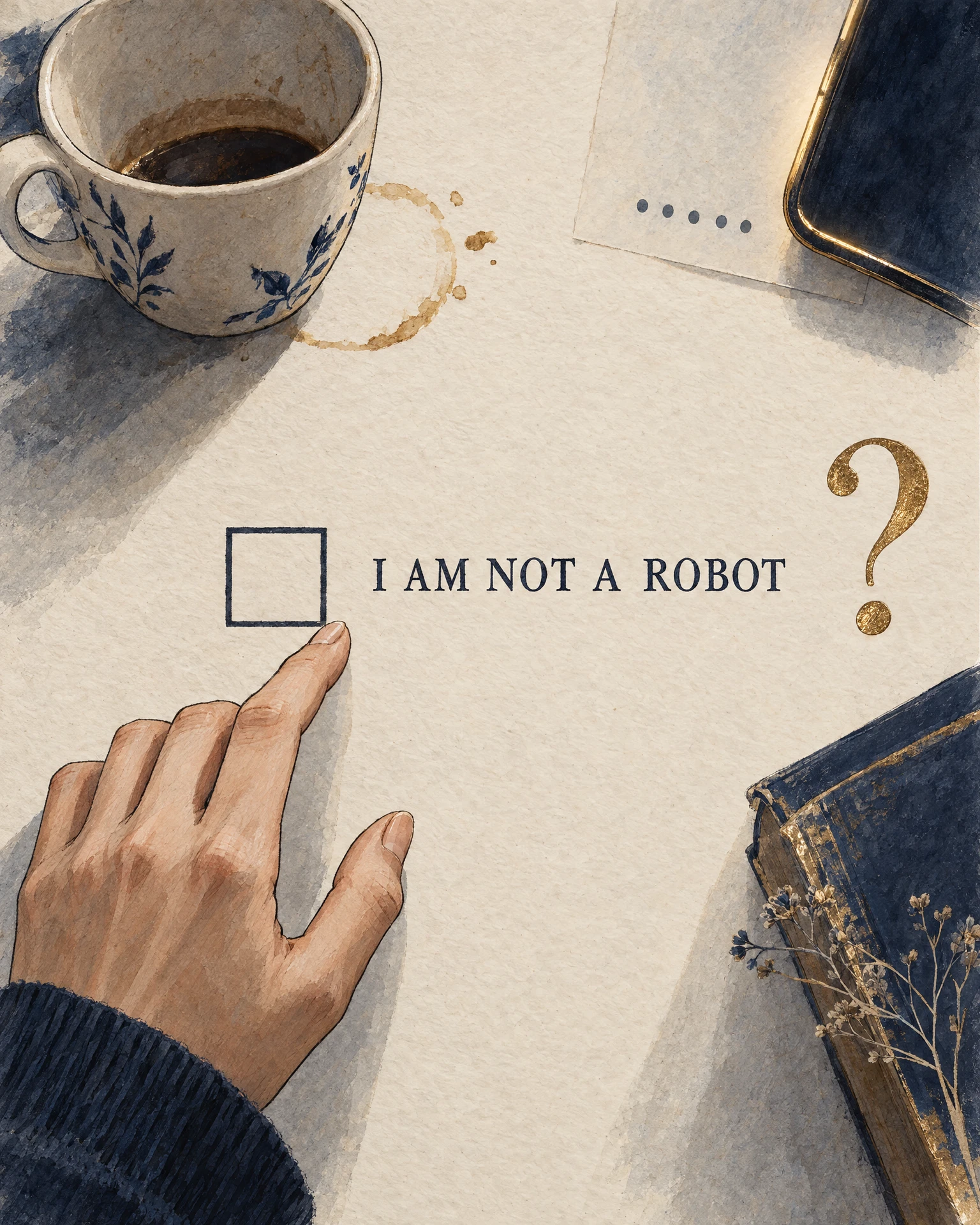
Most mornings I look at my phone before I have properly joined the day. I do not mean to. I wake up, remember that someone needs a jacket, a form, a ride, a lunch, a response, and the phone is already beside the bed doing its quiet little impersonation of a competent adult. There is usually something waiting: a message from school, a calendar reminder, a weather warning, a note from someone I love, or an offer on a sweater that has somehow become urgent before coffee.
I am not making a case against the phone. It is where the school writes to me and where a friend sends a photograph of her baby. It gives me directions to a house I have never been to, shows me the recipe I need after I discover that dinner requires both an onion and a plan, and, by the way, you need to see this visual essay from an adult woman who has turned a kiddie kitchen into a working sink in the minivan they have chosen—or are forced—to live in. It is also where I check a package-tracking page for an item that cost less than the coffee I am now trying to make. The useful and the ridiculous arrive together.
The thing that bothers me is not the phone itself but the way it keeps asking me to account for my humanness. A face scan. A thumbprint. A code sent by text, then a code sent by email, because apparently the first code did not know me well enough. A password that needs a capital letter, a symbol, a number, and the emotional residue of a childhood pet. Finally, a small square appears and asks me to confirm that I am not a robot.
The question is funny until it is not. By the time that box arrives, I may already have spent ten minutes proving that I can access the systems through which I organize work, care, school, money and the ordinary business of being reachable. The ritual makes a structural condition feel strangely personal. We have built daily life around devices that connect us to everything, then we turn around and ask individuals to explain why they are looking at those devices so often.
That is the point I want to make, although it is not a very neat point. The attention problem is not simply that people lack discipline, or that phones are too captivating, or that we have all been duped by shiny rectangles. It is that our responsibilities have been routed through tools designed by companies with a commercial interest in keeping us engaged. A household cannot move school, care, banking, work, transport and the family photo album onto one device, then pretend that frequent checking is only a character flaw.
Ursula K. Le Guin offers a better way of naming the relationship. “Technology is the active human interface with the material world,” she writes in “A Rant About ‘Technology’”. The phone is not a visiting alien, and it is not a moral failure for it to be useful. It is a human arrangement, folded into a household, and then asked to carry a startling amount of ordinary life. Once we see it that way, we can ask the very human question: who is it arranged for?
I sometimes check the weather three times in twenty minutes, as though the forecast might notice my concern and become more decisive. I look at a red circle because a red circle has appeared. I read a message thread when the typing bubble comes and then, absurdly, feel a little abandoned when it disappears. None of this is a noble use of time. Jenny Odell writes that the attention economy can cultivate “a sense of amnesia”: a readiness to give the newest thing produced in the last five minutes the whole of our focus. Her account of resisting it feels accurate to me, not because I think every look at a phone is a catastrophe, but because it describes the way the day can be continually reset before a thought has had time to finish.
Sherry Turkle asks, “As we expect more from technology, do we expect less from each other?” Her question is not an instruction to throw the phone into a lake, which would be satisfying in a movie and expensive in a family plan. It asks us to notice the exchange taking place. When a device becomes the first place we turn for reassurance, coordination, distraction and company, we may have less practice tolerating a pause, asking another person for help, or allowing an unfinished thought to remain unfinished for a minute. That does not mean the phone has ruined us. It means the phone has become part of the emotional weather.
Cory Doctorow calls one part of this “attention rents”: the way a platform can steer us from the result, feed or recommendation we meant to see toward the thing somebody else has paid to surface. The phrase is not delicate, but it is useful. His explanation makes clear that a misdirected feed or search result is not just an unlucky accident of modern life; it can be a business decision. I would not claim that every notification is a con. But when recommendations and search results can be directed toward revenue rather than the thing we asked for, it becomes harder to pretend that the user is simply failing a private test of discipline.
That does not mean every notification is a con, or that people using phones have no agency. It means we should be wary of treating attention as an individual housekeeping problem: put the phone in another room, turn off the alerts, become the kind of person who reads serious books in a chair with good lumbar support. I admire that person. I sometimes am that person. Other nights I lie in bed watching someone restore a dollhouse kitchen while my phone reminds me that tomorrow has three meetings and a dentist appointment. I am not sure the difference between those two evenings is moral enough to deserve a verdict.
Personal habits matter, of course. A rule that makes a house calmer is worth having. A meal where people hear one another is worth protecting. But a rule that cannot survive ordinary life is just a decorative object. The real work is to make better terms with the tools we need: to ask whether they help us coordinate care or merely create more errands; whether they return us to one another or sell the little gaps in our attention back to us as inventory; whether they let us be off duty without making us feel irresponsible.
That is the harder part, because it is not solved by a six-step morning routine. It asks more of the people who build platforms and more of the institutions that have decided a parent, a student, a worker, a patient and a friend should all be available through the same commercially managed doorway. It also asks us to be gentler with each other while we figure it out. We are not failing because we look at the phone. We are living in a system that has made looking unavoidable, then made us feel vaguely ashamed of it.
So when the little box asks whether I am a robot, I still check it. I have a form to find, a weather report to read, and somebody will probably need a ride. I do not have a clean answer for how much of this is too much. I only know that I would like our tools to make room for attention rather than quietly claiming it, and I would like us to stop confusing a very human struggle with a personal defect.
I will probably check the weather again before I leave. I am only trying to remember an umbrella.
Sources I kept close
- Ursula K. Le Guin, “A Rant About ‘Technology’”
- Jenny Odell, “Resisting the Attention Economy”, UNSW Sydney Centre for Ideas
- Sherry Turkle, “Connected, but alone?”, TED
- Cory Doctorow, “Big Tech’s ‘attention rents’”
Editor’s note
This essay is a reflection on everyday digital life, not a prescription for screen use or a diagnosis of anyone’s habits. Technology is woven into work, care, friendship, family logistics and pleasure. The question here is not whether to escape it perfectly, but what fairer terms of collaboration might look like.
Copyright & limited-use notice
© 2026 Juliana Saxberg. This essay is licensed under the Creative Commons Attribution–NonCommercial–NoDerivatives 4.0 International License. It may be shared with attribution for non-commercial purposes only; adaptations and commercial use require permission.